
By Andrew Wootton
Last month I attended two compelling meetings: the NSW Apiarists‘ Association Conference and a webinar hosted by the Sustainable Beekeepers Guild of Michigan. The creativity being applied to the varroa problem is inspiring. I‘ll share some highlights.
Mount Panorama Lookout
Sam Ramsey (yes, he of fat body fame – Dr Ramsey first described how varroa feeds on this tissue rather than haemolymph1) was there to discuss his research on the mite. He is attempting to overcome two problems, a recent broken leg and the longer impact of Trump‘s capricious cut to his funding. Despite these hurdles, he captivated the audience with his description of Kleptocytosis – certainly a new term for me. Calculating the energy requirements for the mite to produce eggs every 30 hours, shows that rather than digest honey bee proteins to re-synthesize yolk proteins, the mite accelerates the process by transferring the vitellogenin directly into the eggs.2 Of course, this suggests there could be many novel interventions to obstruct mite reproduction. These will surely follow, a thrilling prospect.
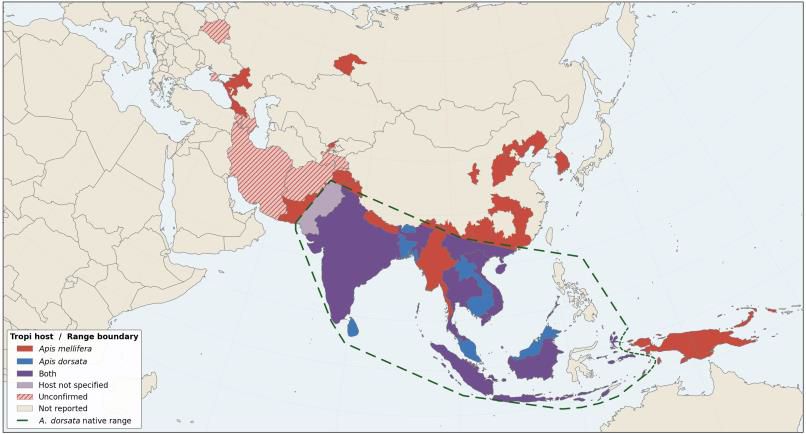
Professor Ramsay also detailed the emerging threat of Tropilaelaps. Worryingly, this more damaging parasite is advancing on three fronts; into Eastern Europe as well as Central and South Asia.3 Perhaps a little more encouraging are the findings that formic acid and thermal treatments can be effective in controlling this new pest.4 Let‘s try to keep Australia Tropilaelaps free!
Michigan Snapshot
Trevor Bawden of Lloyd St Bees and Marquette University, Milwaukee, Wisconsin has devised a new way of estimating mite infestation. The Bawden Assay5 measures mites in brood rather than on the adult bees. This overcomes the shortcomings of the existing mite wash which does not count the more relevant reproductive mites under the cappings (we know that as many as 80% of the mites can be in the brood depending on the season). The test utilises a wax depilatory strip to remove cappings from 200 pupated cells, followed by banging the inverted frame on a brick to dislodge the contents (pupae plus mites). This harvest is then washed and assessed in the usual way, potentially providing a more sensitive metric of varroa infestation. It‘s early days yet and Trevor‘s paper is still in press; we will need wider experience before we can definitively adopt and interpret the results. However, a potential bonus comes with examining the underside of the wax cappings on the adhesive strip. This provides information about the amount of uncapping/recapping behaviour that the colony has been undertaking, giving insight into possible varroa resistance potential. Perhaps we will be able to add this to the pin, liquid nitrogen, UBO and Harbo tests, all of which provide surrogate measures of varroa resistance and are being applied in our breeding programs. Once again, one to watch and I‘ll certainly be trying this assay in spring.
Acknowledgement: Thanks to Kris Fricke for his exemplary work producing the figure showing Tropilaelaps distribution.
Andrew Wootton is Vice President of the VAA and a certified master beekeeper with the Eastern Apicultural Society of N America. He first started beekeeping in the 1960s.
References
1 Ramsey, S.D., Ochoa, R., Bauchan, G., Gulbronson, C., Mowery, J.D., Cohen, A., Lim, D., Joklik, J., Cicero, J.M., Ellis, J.D. and Hawthorne, D., 2019. Varroa destructor feeds primarily on honey bee fat body tissue and not hemolymph. Proceedings of the National Academy of Sciences, 116(5), pp.1792-1801.
2 Ramsey, S.D., Cook, S.C., Gulbronson, C., vanEngelsdorp, D., Evans, J., Posada, F. and Sonenshine, D., 2022. Kleptocytosis: A novel parasitic strategy for accelerated reproduction via host protein stealing in Varroa destructor. bioRxiv, pp.2022-09.
3 Tokach, R., Seshadri, A., Rogers, S.R., Chuttong, B., Jung, C. and Williams, G.R., 2026. Global range of Tropilaelaps mercedesae. Journal of Apicultural Research, pp.1-5.
4 Sankovitz, M., Steinhauer, N., Yemor, T., Cook, S.C., Evans, J.D. and Ramsey, S.D., 2025. Evaluation of efficacy of formic acid and thermal remediation for management of Tropilaelaps and Varroa mites in central Thailand. Journal of Apicultural Research, 64(4), pp.1049-1058.
5 https://www.lloydstbees.com/post/bawden-assay
Fig 1. Tropilaelaps mercedesae distribution, associated Apis host and A. dorsata native range. By Kris Fricke, with data from multiple sources