One full year living with varroa
By Lindsay Callaway
“There is no finish date to life with varroa. So, I keep coming back to a full circle.”
Proudly mounted on my office wall is our first varroa “captured” by my diligent lead apiarists Greg and Lewis, 2nd September 2025. Yes, likely to have been “delivered” on almonds and yes, varroa is a fact of beekeeping life we endure now.
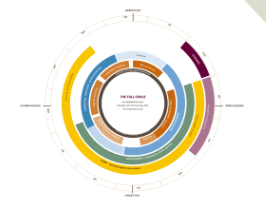
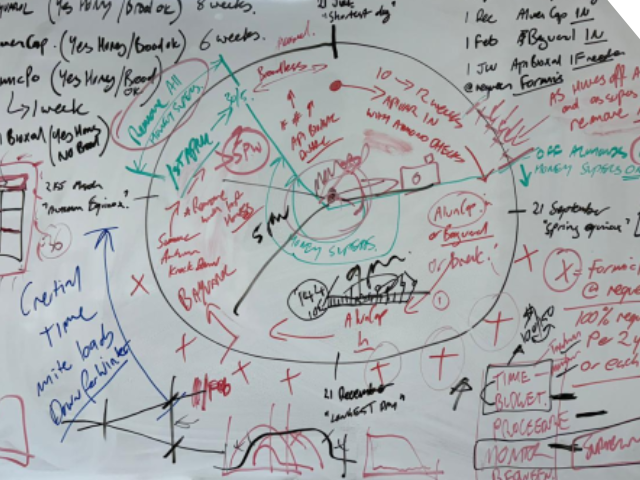
Since varroa arrived, I’ve spent a lot of time standing in front of a whiteboard drawing circles. Not out of madness, but out of curiosity and a desire to understand how this little beast fits into the circle of my beekeeping life.
There must be twenty versions by now. Some neat. Most definitely not. Treatments get written in, crossed out and moved. Honey flows appear. Almond pollination window is a staple feature. Queen rearing gets squeezed in. Brood levels rise and fall. Mite numbers change. Then more information arrives, normally by collaborating with fellow commercial beekeepers and then I start drawing it all over again. Like a sniper adjusting his scope, it gets sharper and sharper in its focus.
But the basic idea has remained the same.
Varroa is now with us all year, every year. There is no longer a start date and no finish date.
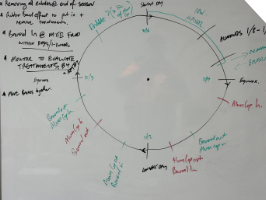
You could represent that with a straight line stretching forever. An infinity symbol would probably be even more accurate. But for me, a circle works better because it gives the year context, rhythm and structure.
It allows me to see the seasons. It lets me overlay honey flows, pollination services, brood cycles, nutrition, queen rearing and the times of year when we want to leave the bees alone.
And then, importantly, I can overlay where the varroa treatments fit best, work best for my operation and my bees. The result isn’t a perfect treatment plan. It is a planning tool and one I keep refining as we learn the dark art of managing varroa.
Start with four points
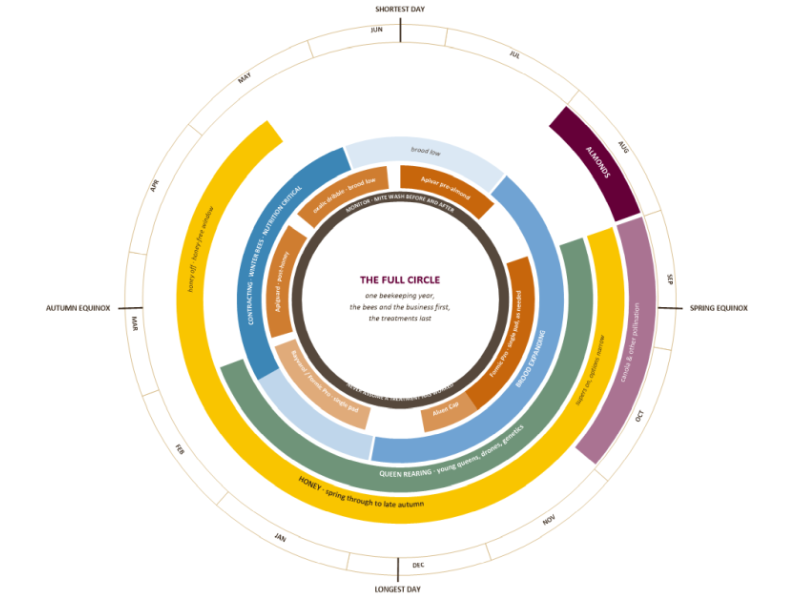
My circle starts empty. I first mark the shortest day, longest day and the two equinoxes. Those four points divide the year into quarters and immediately give the circle some context. Then I start adding our beekeeping year.
August gets blocked out for almond pollination. In our operation, pollination increasingly extends beyond almonds into September and October. This year, around three-fifths of our bees have continued from almonds into other pollination work. I see this window growing both in terms of volume of hives and length of pollination time as the unmanaged “naturalised” Apis mellifera gets wiped out by our “foe,” varroa.
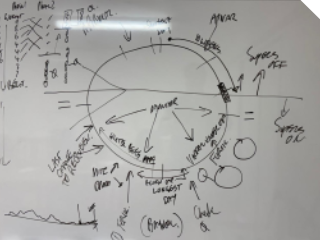
Then comes honey production. For us in Victoria, the broad honey window is from spring through to late autumn.
Then add queen rearing. For us, that window runs roughly September through to late February or early March. After that, cooler weather and falling drone populations start closing the queen-rearing door, as does the time needed to get the new hives established pre-winter, strong enough to “show up” to almond pollination on August 1st.
Already the circle is becoming a useful visual tool and we haven’t even put a varroa treatment on it.
“Put the bees and the business on the circle first. Put the treatments on last.”
Now put the bee on the circle
The next layer is what is happening biologically inside the hive.
When is brood expanding? When is it contracting? When are we building our long-lived winter bees? When is nutrition critical? When are we likely to have our lowest brood levels? Where are the varroa hiding or in some cases not hiding?
Varroa development follows the seasonal development of its host. As brood and adult bee populations decline, the proportion of mites on adult bees can rise sharply. The national Australian IPM guidance identifies late summer, and autumn as the hive population-decrease phase, the period when colonies are producing overwintering bees while varroa is completing its final population growth phase — yes, it wants to survive too.
That makes late summer and early autumn a critical part of my circle. This is where nutrition becomes every bit as important as the treatment program.
Australia has some enormous advantages here over, for example, our friends in the US and Canada. We have extraordinary nectar and pollen resources and, in many areas, opportunities to position bees onto good nutrition when they need it most, while they are producing their “winter” bees. We don’t need horrible tankers of sugar and half-baked patties of nutrition when we have great access to resources.
But there is also a lure for commercial beekeepers. A big honey crop isn’t necessarily the same thing as good bee nutrition. Flows such as ironbark Eucalyptus sideroxylon (Red Ironbark) and Eucalyptus tricarpa (Ironbark), grey box Eucalyptus microcarpa and blue mallee Eucalyptus polybractea can produce plenty of honey, but they aren’t necessarily where I want bees sitting for extended periods while trying to build the best possible bees going into winter.
There is a trade-off.
We still want heavy hives and plenty of stores going into winter. A short period on those flows can be commercially valuable and help pack bees down with honey. But varroa is forcing me to think harder about what pollen those bees are eating at the same time.
“The best honey flow for the beekeeper isn’t necessarily the best pollen flow for our bees.”
Our first lap around the circle
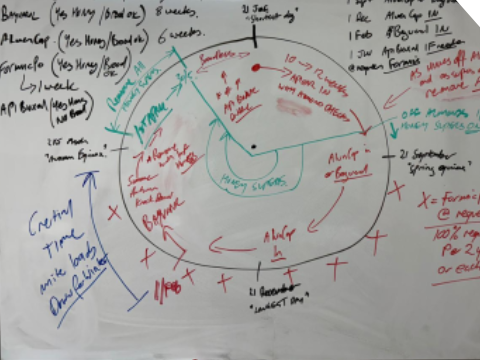
While we detected mites in September 2025 and monitored to what I would call a “fairly good” standard, January 2026 was really the beginning of our first full lap. The “denial” period had to end and we had to start with the reality of putting in treatments.
We started with Bayvarol, but were met by what I can only describe as a great big wall of honey.
Our bees had done exceptionally well on my late mum’s favourite honey, the mighty river red gum Eucalyptus camaldulensis. That’s normally a pretty good problem to have, but suddenly we had thousands of hives carrying a huge amount of honey and we needed access to the brood nest, fast!
We were a little late getting Bayvarol into some loads. Not only were we faced with the awkward dance of getting past the most welcome wall of honey, we had the added logistical effort to move the hives off the rivers and onto summer-flowering ironbark, brood populations were contracting and in places our mite washes moved into double figures!
In hindsight, it was almost a textbook demonstration of why the circle matters. Everything was happening at once: honey production, nutrition, brood contraction, operational workload and increasing varroa pressure.
Alongside Bayvarol we trialled a single pad of Formic Pro treatment across 16 loads as a temporary measure while honey was being removed and the Bayvarol team caught up.
That was my introduction to using formic. We observed beautiful brood rearing following treatment, particularly, and unusually, as the brood expanded on ironbark bees. I think the summer rains helped the Chinese scrub Cassinia arcuata yield timely pollen and helped the bees expand, a happy coincidence.
My observation was that the formic put the bees into a hygienic frenzy and subsequently the bees opened the brood nest, unpacking all the “bee bread” stored from spring flows and the river red gum. We also observed a reduction in field bee numbers after formic treatment. But those same loads have subsequently developed into strong, healthy colonies through winter and into spring 2026.
It wasn’t without a field force loss: adult bees with varroa feeding holes couldn’t bear the brunt of the formic and perished. But it gave us another tool and, importantly, more treatment experience.
Bayvarol ultimately worked extremely well for us, and while it was a marathon to get all the treatments in and the treatments out, it ran parallel with the winter bee production period. After the treatment period we were seeing zero mite counts across all loads, mites became undetectable.
That was then. The situation has changed remarkably quickly.
Resistance changes the circle
In 2026, resistance to both major synthetic chemical groups was confirmed in Australia. Agriculture Victoria has now confirmed some Victorian varroa mites resistant to the pyrethroids Bayvarol and Apistan, as well as the formamidine products Apivar and Apitraz.
That doesn’t mean every mite in Victoria is resistant. Our own experience demonstrates why monitoring matters. Both Bayvarol (summer-autumn) and Apivar (winter) produced very low mite counts, largely undetectable. But neither product can simply be assumed to work anymore. Bayvarol may work one more time for us, Apivar may be something we can return to semi-regularly into the foreseeable future. The experts say that with a good organic centric program, formamidine products can still be “reasonably” effective. With Bayvarol it’s a switch that is permanently turned off.
And that is probably the biggest change resistance makes to my circle: monitoring leads the treatment program, which is now largely organic based treatments. Organic treatments have no known mite resistance; however, they bring their own set of challenges.
The national guidance similarly recommends monitoring before and after treatment and rotating control methods rather than relying repeatedly on the same chemistry.
In my apiaries,, our tolerance for allowing increasing mite numbers is going to be very low through this acute transition period of the next two seasons. We have treatment stocks on hand, we’re monitoring extensively, and we want to know whether something has worked, not simply assume it has because we put it in.
“Putting a treatment in isn’t the same thing as controlling varroa. The mite wash afterwards tells you whether it worked.”
Winter, almonds and lessons from year one
After the 2026 shortest day we began our pre-almond program.
Most of our loads that were honey super free received Apivar while simultaneously being assessed for hive strength. The plan was to have that treatment period dovetail with almonds and remove the strips as the bees came off almonds.
We also trialled Aluen Cap on loads that still had honey supers on. The mite results from those Aluen Cap loads were excellent in early spring, predominantly zeros with the occasional one or two mites in individual washes. But I wouldn’t choose that timing again for Aluen Cap. My observation was that treating with Aluen Cap in the depths of winter knocked the bees around more than I was comfortable with. That’s not a criticism of the product; it’s a lesson about where that product belongs on our circle.
Good autumn 2026 nutrition in the mountains, followed by excellent winter conditions in the Mallee after substantial pre-winter rain, gave us good strong colonies. Overall, they averaged well on almonds and met our pollination customers’ requirements.
Getting Apivar out after almonds took us around a week longer than I wanted. Boggy conditions, hive movements and the sheer logistics of moving many colonies meant reality got in the way of the whiteboard. That is another lesson worth putting in print.
The perfect IPM program on a whiteboard still must survive contact with a commercial beekeeping operation.
Spring: honey on, options down
Coming out of almonds changes the circle again.
Honey supers go on, resistance is in the “air,” and suddenly the range of treatment options narrows.
Our current focus is extensive monitoring combined with Formic Pro as needed, single-pad application, repeat treatments where appropriate. Aluen Cap also gives us another organic-acid option to consider as we learn more about where it best fits our system. More than likely at the end of spring, after formic treatment/s is where it will fit best for our operation.
The exciting part for me is that we are gradually building enough experience to stop thinking about these products individually.
Instead of asking, “What treatment should I use?” the better questions are:
Where are we on the circle? What is the brood doing? Is honey on? What are the temperatures? What did our last mite wash say? What treatment did we use previously? What is happening with queens? And what do we need these bees to be doing in six or twelve weeks?
That is IPM in a commercial context.
Young queens: the hidden engine
There is another layer around my IPM circle that is becoming more important than ever. Young queens. Our main queen-rearing window runs from September through late February or early March.
Alongside producing quality cells and queens, we’re putting more emphasis into genetic improvement, monitoring our breeders’ hygienic behaviour and “potential” varroa tolerance, and deliberately building drone populations around our mating areas.
Our ambition this year is to produce a flooded drone congregation area of more than four million drones from selected lines to mate our virgin queens under.
We’re also exploring whether treatment and requeening can eventually work together. One idea I have is the large-scale use of protected queen cells across entire loads in conjunction with our spring and/or late summer formic programs. Exactly how the “mechanics” of this might work isn’t clear to me yet. Does the protected cell go in before treatment, during it or afterwards? Will the virgin replace the old queen, fail, or potentially coexist for a period?
I don’t know yet. But if a commercial operation can efficiently produce thousands of cells, providing every colony with an opportunity to introduce young, selected genetics is an exciting IPM tool to explore. There are a lot of unknowns, particularly with formic. I remember telling some fellow commercial beekeepers late last summer that I “trialled” formic on 16 loads, they were all laughing because they thought I nuked all my queens. I just laughed with them and said if the queen was too old to survive, that’s good, as I don’t want to waste my time with her through winter only for her to fail when I need her most, going into almonds.
“The hidden engine to drive success in my varroa circle is the queen.”
Autumn: preparing for the next lap
Eventually the circle comes back around.
Honey comes off. Brood begins contracting. We are finishing building the bees that must carry colonies through winter and propel us into pollination and beyond.
Our vertical barrier system becomes particularly valuable here. After a trip to New Zealand in 2017, we deliberately developed a system that clearly separates our honeycomb from our brood equipment. Different combs and frames allow us to remove the honey crop and get colonies back to a defined brood nest.
That gives us a genuine honey-free treatment window. Apiguard is one treatment we’re interested in using during that post-honey autumn period where appropriate. In late autumn, as brood approaches its seasonal low, oxalic dribble becomes another tool of particular interest to us.
Then we’re approaching the shortest day again. And the circle starts another lap.
Where I want the circle to take us
Longer term, success for me isn’t adding more treatments to the circle. It’s hopefully removing as many as possible. I’d love to reach a position where mite numbers are low enough going into winter that we’re not opening hives unnecessarily and putting treatments in during the lead-up to almonds.
Likewise, I want bees entering summer with low mite levels, young queens and good nutrition so that we can leave them alone as much as possible while they’re on peak honey flows.
Treat hard when we need to. Monitor relentlessly. But create periods where the bees can simply be bees.
Resistance will take Bayvarol and possibly Apivar completely out of our program. Other products will move around the circle as we learn more. Genetics should become increasingly important in jumping off the treatment treadmill. Pollination will continue changing our calendar. And that’s all okay.
The circle isn’t the treatment program. The circle is the framework that allows the treatment program to change.
Draw your own circle. Perhaps the most useful thing about all those messy whiteboards is that my circle definitely shouldn’t be your circle.
A beekeeper in Queensland will draw a very different one to a New South Wales beekeeper. Another Victorian commercial beekeeper may have completely different honey flows, pollination contracts, queen-rearing windows, nutrition, brood cycles and philosophy towards treatments.
So rather than publishing “my circle” as a recipe, I’d like to offer it as a signpost.
Start with a blank circle. Mark your longest and shortest days and your equinoxes. Add your pollination jobs. Add your honey flows. Add your queen-rearing window. Think about brood and nutrition. Identify the periods when you want to leave your bees alone.
Then overlay your monitoring.
Only then start writing treatments onto it.
Treatments will change. Resistance will change them for us. Seasons will change. Our queen breeding will change. Pollination will change. Unmanaged honey bees will be decimated and probably leave us scars to remember them by. Things I’ve written on this year’s whiteboards will undoubtedly be rubbed off next year.
But the circle will remain. Shortest day. Almonds. Spring. Other pollination jobs. Honey. Queens. Summer. Nutrition. Winter bees. Autumn. Brood contraction. Endless monitoring.
There isn’t really a varroa season anymore.
There is just the next “continuous” lap.
KEY MESSAGES
- Varroa management is 365 days a year. Think in cycles, rather than individual treatments.
- Monitoring leads the program. Never assume a treatment has worked.
- Put the bee before the treatment. Brood, nutrition, queen age and colony strength belong on the circle.
- Plan around the business. Honey flows, pollination and operational capacity determine what is actually possible.
- Resistance changes everything. Preserve treatment options and expect the program to evolve.
- Young queens and genetics are part of IPM.
- Draw your own circle. The framework is transferable; the treatment recipe isn’t.