By Nathan Whitford, President
Ask a member of the Geelong Beekeepers Club what makes it hum and you’ll rarely hear about hives, equipment or honey. You’ll hear about people. We are a not-for-profit, volunteer-run club of around 275 members, and everything we do, from delivering our fully booked Beekeeping Essentials Course to staffing a stall at the Royal Geelong Show, happens because someone put their hand up.
A club that nearly wasn’t
Our story starts at the turn of the millennium. Club records differ on whether the first meeting was held in 1999 or 2002, but the reason for it is not in doubt. At the time, the only beekeeping meetings were held in Melbourne by the VAA’s Melbourne Section, which meant a trip to the city for anyone in Geelong who wanted to learn from other beekeepers. Founding member John Edmonds set out to form a club closer to home. Not everyone was convinced the region could support one. Early meetings drew just 12 to 15 beekeepers, and John paid the first year’s hall rent of $200 himself, hoping the club would take off. That small group of new beekeepers and seasoned professionals, meeting monthly to learn and network, is where today’s club began.
Like many community groups, we have had our wobbles. In 2014 a run of changes almost caused the club to fold. Gary Montgomery stepped in as President and formed a new committee. He shifted the club’s focus to be more inclusive of recreational beekeepers, who remain the heart of our membership.
That shift shaped the club we are today. Gary was instrumental in starting three things we still rely on: our meeting format; the Ask a Beekeeper sessions, with experienced beekeepers on hand to help newcomers; and the Beekeeping Essentials Course. He also helped start our association with The Heights, a National Trust Victoria homestead in Newtown dating back to 1854, where the club still keeps its own teaching hives.
Founding members John Edmonds and Stan Filippis were made Life Members in 2022, followed by Gary in 2024 and Helmut Woerner in 2025 for his years of mentoring, technical help and outreach. Our Life Members say a lot about the club: people who give their time and knowledge to others.
Education is what we do best
Each meeting opens with an Ask a Beekeeper session, where members can put any question to a panel of experienced beekeepers. This is so popular we run a beginner and experienced beekeepers session simultaneously in two different rooms for 45 minutes before the general meeting. Participants always have to be told when it’s time to cut off the discussion and convene. The general meeting begins with a monthly biosecurity segment – a member survey helped us settle the running order and start times.
The Beekeeping Essentials Course is the front door for anyone thinking about taking up beekeeping. One doesn’t need to be a member to enrol, but the course includes a year’s club membership, so new beekeepers have the club’s support through their first year. In 2025/26 we ran four, in August and October 2025 and February and March 2026. All were fully booked. We encourage new members who want hands‑on practice to come along to our hive openings at The Heights. These small‑group sessions are designed to help build confidence in a supportive, relaxed setting. It’s a great chance to see how a hive works, ask questions and get comfortable with the basics, and a good “try before you buy” opportunity if you’re still deciding whether beekeeping is for you.
Our club maintains a strong library of resources to support your beekeeping journey: recorded guest speaker presentations, practical guides, biosecurity updates and a full archive of past newsletters. Financial members are welcome to borrow from the club library at no cost.
Every two years we host a book sale featuring some of the best beekeeping books at up to 40% off the recommended retail price (cheaper than QBD and Amazon). Plus, our website offers a fuel discount program that anyone can use, even non‑members.
Punching above our weight
For a volunteer-run club, we are lucky to attract some of the best speakers in the business. In the past few years we have hosted dozens of presentations, from Agriculture Victoria (AgVic) biosecurity staff and Varroa Development Officers to university researchers, commercial beekeepers and international guests.
Recent highlights include Dr Jody Gerdts, a Benalla-based queen breeder and researcher who has studied Varroa-resistance breeding programs in the United States; Cormac Farrell, head beekeeper at Australian Parliament House, on urban and rooftop beekeeping; Dr Kenya Fernandes, a University of Sydney microbiologist who explores how forest health and bee health shape the antimicrobial properties of honey; and Dr Scarlett Howard of Monash University, who studies bee intelligence and cognition.
We have also made a point of showcasing women in beekeeping and bee science, and of bringing a diverse range of voices into the room. Alongside Drs Gerdts, Fernandes and Howard, we have heard from Dr Nadine Chapman on Plan Bee, Australia’s honeybee breeding program; Dr Shona Blair on the medicinal properties of honey; Tina Sebestyen on integrated pest management; and Ally Driessen on biosecurity.
Our biosecurity line-up has been just as strong. AgVic’s Adam Maxwell has outlined the National Bee Pest Surveillance Program; former Varroa Development Officers Scott Denno and Kris Fricke have briefed us on monitoring, cultural control and organic acids; and VAA Vice President Dr Andrew Wootton has spoken to us on hive splitting and, recently, the Bawden Assay as an alternative to the alcohol wash.
Our speakers have also taken us well beyond Geelong, with talks on beekeeping in Washington State, Uganda and elsewhere in Africa, the black beech honeydew of New Zealand, and the Apimondia congress. Some of our best sessions still come from our own members, including John Edmonds on honey judging and the season ahead, Stan Filippis on queen rearing and winter pack-down, and Stephen Fridey on summer hive maintenance and preparing for Varroa. They stand up and share what has worked, what hasn’t, and what they’d do differently.
Getting ahead of Varroa
No topic has shaped the club more than Varroa, and it is now in the Geelong region. Our approach has been education first, with practical help for members so we aren’t caught out.
In July 2025 we successfully advocated for a second National Varroa Management Training course to be held in Geelong. About 70 people attended, despite a Geelong Football Club home game on the same day. It showed how hungry local beekeepers are for practical, evidence-based training.
Behind that sits our Varroa Sub-Committee, a group of members who have given countless hours to developing practical Varroa management modules. Topics include drone capture and removal, queen caging and brood breaks, and total brood removal. The modules are presented at meetings and published on the club website, so members who miss a night can catch up. We’ve also run “spot the Varroa” hands-on sessions, because there’s no substitute for seeing the real thing under a magnifying glass.
To build a local picture, we created GBC Varroa Watch, an online system where members record alcohol wash results and hive losses. Members can see amalgamated results for their area, and the committee uses the data only to help members plan and respond. Members still log results with BeeMax to meet AgVic requirements.
Our member zones (North West, North East, Central North, Central South, South West and East) connect members with neighbours who can share resources, ideas and help, including coordinating treatments.
We have also taken up a practical problem for hobbyists. Treatments available under emergency permits are mostly packaged for much larger operations. In our club, 62% of members run fewer than ten hives and a quarter have just one. We have raised the issue with AgVic, the VAA, CAP Products Australia and the Australian Pesticides and Veterinary Medicines Authority (APVMA), and encouraged other clubs to do the same. The responses have been constructive, and we’ll keep advocating for smaller-scale beekeepers.
Connecting with the community
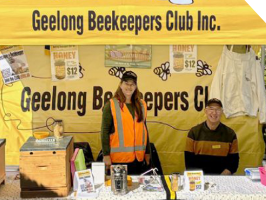
Bees interest far more people than just beekeepers, and we try to meet that interest. Our volunteers staff stands at the Royal Geelong Show, Le Festival Français, the Ceres Makers Market, Bunnings events and The Heights Heritage House & Garden Autumn Fair. They also present to groups across the region, including Probus clubs, retirement villages, nursing homes, community health groups and schools. A suite of presentation materials helps volunteers feel confident and deliver a consistent, evidence-based message.
In December 2024 the club donated 222 jars of honey to the Geelong Food Relief Centre, a local charity that supports more than 55 frontline organisations. John Edmonds helped us produce and package the honey to proper food standards so it was traceable and high quality.
We have also grown our media profile. We’ve appeared on Pulse FM’s Local Legends, and nine weeks of free commercial radio public service announcements have aired three times daily across 3GL, K-Rock and Bay FM. This was made possible by the generosity of Geelong Broadcasters. Those messages have introduced the club, and the importance of bees, to thousands of people across Geelong and the Surf Coast.
Making the club accessible
We want the club to be open to anyone with an interest in bees, wherever they live.
We have started live streaming our meetings, so members who live outside Geelong, or who can’t get to a meeting in person, can still take part. For $12 a year, anyone can also join as a newsletter-only Friend of the Club. Our newsletter is often regarded as one of the best around. Each issue includes a seasonal report from John Edmonds, a bee biology series by Bruce Ward, Varroa updates, zone news, book reviews, items for sale and agistment offers.
Local businesses such as Edmonds Honey and Meleebee Farm support our events and prizes.
Challenges
Our challenges are those of most community-based, not-for-profit groups. We depend on volunteers, and a small group carries much of the load. Committee roles, event shifts and speaking engagements often rely on the same willing people. We say plainly at every AGM that no committee means no club.
Varroa adds a second pressure. As it spreads, demand for information, training and mentoring grows, and so does the workload on those who provide it. We are building our resources and systems to keep up, but volunteer time remains the limit.
Looking ahead
If we had to sum up our approach, it would be this: share what you know, make it easy for others to learn, and look after one another. The strength of the club has never been measured by the number of hives we collectively manage. It is measured by the number of people willing to share knowledge, lend a hand and contribute to something bigger than themselves.
We try to work with other clubs whenever we can, including Ballarat, Werribee and Southside Beekeepers. There’s no benefit in reinventing what already works well, and collaborating helps all our members access better resources, knowledge and support.
If you’re ever in Geelong on the third Friday of the month, come along. There’s always a seat and a question waiting to be answered.
Geelong Beekeepers Club Inc. meets on the third Friday of each month at the Masonic Hall, Belmont. Find out more at geelongbeekeepersclub.org.au