
September 2026
The beekeeping landscape here in southern Victoria has changed a lot in the last fifty years due to canola. In the 1970s some farmers at Balliang were growing rapeseed, and my father would shift his hives to the flowering crops. The crops flowered in October, and the bees bred rapidly and made 20 kg of water-white honey that tended to candy quickly. A super of foundation combs would be drawn and filled. We would use Demaree boards to make a split to reduce swarming and raise a new queen on top of the hive. The bees would become nasty and every hive opened would sting you. In those days protection was scant: no gloves, just black netting veils and work clothes, until we started wearing white boiler suits. A new beekeeper who came along to learn kept his hands in his pockets because he was frightened of the stings. The first job was to go along the fence posts and catch the swarms, as every hive would swarm. The change occurred when the Canadians bred a better plant for the oil, with low acid content, and called it canola. Nowadays it flowers in southern Victoria as early as late July or August, and by the end of September it will be finishing, except for the odd late crop. So our season starts much earlier. Prior to canola, capeweed [Arctotheca calendula] flowered in mid-September and October and was the first plant to build the hives up to a swarming fever. It made an unpleasant-flavoured honey that spoilt the nice yellow gum [Eucalyptus leucoxylon] honey.
My observation is that canola needs to flower on warm days (above 18 degrees) and the ground needs to be dry to yield nectar that increases hive weights. Even so, excellent breeding occurs as copious pollen is harvested. The problem locally is that the cold south winds off the sea hamper the bees’ foraging.
Large areas of roadsides and unused land have been covered in the yellow flowers of soursob [Oxalis pes-caprae]. This plant seems to be expanding, and the bees collect pollen and a thin nectar from it.
September 11th – Despite a nice warm day and no wind, the hive scales have reported an increase at only one crop. The other four canola crops are still only slightly up or down each day, yet the hives are breeding well, eating into the honey stores to make more brood and many drones.
I have just finished putting out the first queen cells for the season. I waited for the weather to warm up. The overwintered nucleus hives have been split, and with the canola midway through flowering, I expect to see some nice laying queens at the end of September. The last two springs were frustrating, as cold, windy days interfered with the mating flights.
September 13th – A nice warm 24 degrees, but a strong afternoon wind. The hive scales again showed topsy-turvy results: generally the hives increased in weight, but the two crops that had been consistently the best recorded losses. Both crops are at peak flowering. At one site the canola may be finishing, but faba bean crops further away are yielding, judging by the pollen in the frames.
Swarming has started, especially in hives that have not been attended to. Extra supers, or splitting away a couple of frames of brood and adding foundation, will prevent swarming.
It is a good idea to split your hives during the spring build-up to prevent swarming and, most importantly, to have replacement nucs. New South Wales beekeepers have found they need a third of their hive numbers in reserve to make up for varroa-generated losses.
Plantain has its first flowers, and an almost white pollen will be gathered.
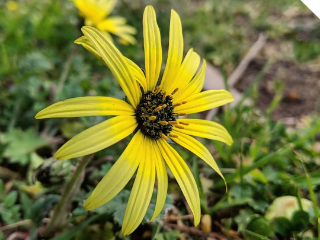
Capeweed is prolific in some paddocks, and the first flowers have started but need to develop their pollen stamens before the bees will work it.
Pelargonium, known as cranesbill, has small mauve flowers opening.
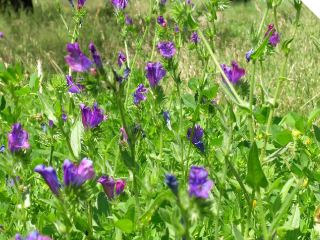
Paterson’s curse [Echium plantagineum] is flowering better this year due to the good rains. My friend’s scale hive in the Riverina reports increases of 1 to 2.5 kilograms per day.
Sweet pittosporum [Pittosporum undulatum] is flowering, and the bees love the flowers. This tree tends to be a weed in many places.
Wattles of various species are flowering throughout the bushlands. It appears flowering is delayed for sallow [Acacia longifolia] and prickly acacia.
Coastal teatree [Leptospermum laevigatum] has its first flowers and is often found with bearded heath [Leucopogon parviflorus], which breeds the bees very quickly. Beekeepers report their hives at Point Lonsdale have filled with honey, most likely teatree.
Yellow gum and red box [Eucalyptus polyanthemos] are budding and flowering through central Victoria. The flowers are full of nectar and the bees are gathering it.
Grey box [Eucalyptus microcarpa] is making growth that looks promising for next autumn.
Ironbark [Eucalyptus tricarpa] at Bendigo is growing new tips; could it flower in successive years?
Sugar gum [Eucalyptus cladocalyx] is growing rampantly, but once again it is hard to tell whether it will flower next autumn or the following year. Various stands appear to be at different stages of bud development.
The almond growers are pleased with this spring’s pollination and a good set of nuts.
September 21st – As the country starts to dry, the dryland canola crops are finishing flowering. The colour of the flowers turns from bright yellow to a golden hue. Although the bees still work the flowers, the yield drops off quickly, especially after the strong, hot north winds over the weekend.
Beekeepers are reporting that the canola has not made honey as it has in previous years. The bees breed well with little weight gain. Is it the varieties of canola? Or the cooler weather during flowering? Or lack of ground moisture? The hives are very strong and will now need to be shifted to another flowering source.
A farmer told me that they will spray the canola with a desiccant and harvest it while standing. The reason is that cockatoos and parrots decimate the windrowed crop.
My friend is pollinating two new varieties of canola for seed production at Hay. These varieties have never been grown here before. One variety yields huge amounts of pollen, with bees coated in pollen as if they had been on pumpkins.
September 27th – The cold southern wind stopped the hives’ weight gain, and many of the canola crops appear to be almost finished flowering and yielding nectar.
Bogong moths [Agrotis infusa] have started to migrate, and if they come south, they will affect the flowering of the eucalyptus trees. The moths walk over the flowers at night, leaving a smell that repels the foraging honey bees. Many good honey flows of yellow gum, red box and yellow box [Eucalyptus melliodora] have been stopped by them in the past.
September 28th – Today I was pleased to inspect two hives at Bellbrae. It has become a hotspot for varroa after beekeepers shifted bees with varroa into the area in March. In June the hives averaged 50 mites per wash. I added oxalic acid strips. After winter, in August, I found the mites had dropped to 20. Now, in late September, one of the hives had swarmed and made a new queen. During the brood break the varroa numbers had dropped to 8 mites. The second hive had filled with more honey and needed more room. Its count was 9 mites in the wash, and uncapping drone brood found none. I am happy the oxalic acid strips are containing the varroa. The strips have been chewed, but enough remains to be effective. Replacement strips will be installed next month.
I noted an absence of New Holland honeyeaters [Phylidonyris novaehollandiae] around my property. This week many have moved in and are feeding on the bottlebrushes [Callistemon spp.] and broadleaf paperbark Melaleuca viridiflora. They must migrate in from unknown areas. Shortly, hundreds of them will be here nesting and chasing each other in flocks.
Varroa
I found two five-frame nucleus hives to have one and two varroa mites respectively. Oxalic acid strips were placed in them. The one with two mites had strips placed as staples. The one with one mite had one strip laid on top of the frames. An inspection three weeks later found that the nucleus with the stapled strips had only one mite after uncapping all the drone brood. The nucleus with the strip lying on top of the frames had 10 varroa mites, so clearly that didn’t work; an extra oxalic acid strip was added and both strips were placed as staples.
While placing oxalic acid strips into a hive and uncapping drone brood, I was wearing nitrile gloves. I found an unmarked queen. I held her with gloved fingers and marked her. When I released her, I was surprised to see a bee immediately grab and attempt to sting her; I intervened and hopefully prevented her from being stung. Why did this happen? I guess the gloves had traces of oxalic acid on them, and the bee disapproved.
A friend is confused. He split his apiary and shifted half to yellow gum and red box. He was surprised to discover a canola crop within flying distance. He has been “vaping” the hives each week. Inspection found low levels of varroa in the shifted hives, but the hives remaining at the faba beans, which have received the same vaping treatment, have high numbers of varroa. It must be reinvasion, but from where? No other known apiaries are nearby.
Another friend has taken her hives back home to northern NSW from the almond pollination and found large numbers (70 per wash) of varroa in them. She applied a formic flash treatment, but the varroa numbers were still higher after the treatment.
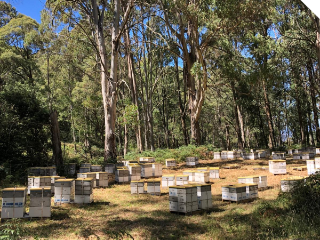
When I uncap drone brood, I used to return the dead drones to the hive, as the bees eat them for protein. Then, when I started to find the odd varroa, I decided to discard the dead larvae on the ground rather than risk recycling the mites. I wondered what would eat the pupae. At a bee site with meat ants [Iridomyrmex purpureus], the larvae disappear as fast as they hit the ground. At another bee site I discovered a crow had been watching, and he would follow me around eating the pupae and any dead bees he could find.
I have found hives with no varroa amongst infested hives. Kris Fricke suggests they may just be lucky not to have been infested yet as varroa spreads unevenly through the apiary.
The Geelong Beekeepers Club has been very active, making a set of presentations covering various topics to educate its members. The next project is getting members and other beekeepers to record the varroa levels and discover hives that have reduced or no varroa. Then these strains of bees will be bred from, and the queen cells distributed to club members. The hope is to breed bees that adapt to the local environment and are varroa-resistant. I expect this project will take time.