
By Kris Fricke
Researchers in Queensland have found spider venom peptides that kill 100% of varroa and 0% of honey bees.1 This is obviously a good thing. I’ll admit I was slow to read up on this because it seems there’s a new varroa wunderwaffe every week and most don’t turn out to be anything at all, but having read up on this, it’s actually interesting.
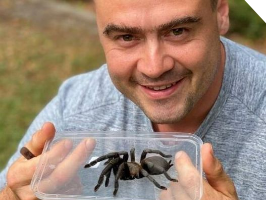
Many spiders prey on fellow arachnids, so the study’s author reasoned their venom must be effective against varroa mites, which are arachnids. There are over 53,000 spider species and >2,800 scorpion species, but fortunately lead researcher Dr Volker Herzig has the world’s largest “biobank” of arachnid venoms, with samples from 870 species (he says he has milked over 6,000 spiders and 2,500 scorpions and never been bitten or stung!). He took the venom of 50 different species and tested their venom against varroa, and 78% of them resulted in 100% mite death in 24 hours. He then selected two (of the 13 that had caused 100% mite death in two hours) to do further testing on: the Tasmanian cave spider Hieckmania troglodytes and the giant Japanese funnelweb spider Gigathele gigas, which are from different spider families.
Already knowing it was lethal to varroa he just needed to make sure it was not harmful to honey bees and humans. He applied a proportionately larger dosage to honey bees (to account for larger size) and it killed none of them (in the long run everything dies, but they looked at the survival of the honey bees for the following 20 days and altogether “the dose that caused lethality to varroa mites did not alter honeybee survival relative to the [control].” What’s interesting though is that the venom peptide used (Ht1a) has the same effect on both varroa and honey bees on a molecular level, but in actual topical application has no adverse effect on the bees while being lethal to the varroa. And, most importantly, they needed to test it against human affects, and found no significant effects at the dosages they were looking at (which is not nothing, and not surprising considering the funnel-web spider has a bite that can hospitalize you, but as they say it’s the dosage that makes the poison).
So how does it actually work? They isolated a peptide (a smaller simpler cousin of a protein) from the venom of each of the two spiders that was most effective against varroa and studied and produced these peptides in the lab in order to study their effects. The Tasmanian cave spider peptide (Ht1a) works against the “voltage gated sodium channels” which you may remember from Andrew Wootton’s article2 on pyrethroid resistance. Pyrethroids lock open the sodium channels, which lead to them being flooded with sodium ions, causing membrane depolarization and “excitotoxic paralysis.” These venom peptides do the opposite, suppressing the sodium channels, which makes nerves less likely to fire, eventually leading to mite death (they note this is a slower effect than oxalic acid, which was one of the controls). They have not yet studied the effects of the Japanese web-funnel spider’s venom peptide in as close detail as the Tasmanian cave spider’s.
From the behaviour of the effects, it is probable that it acts on a different binding site than pyrethroids do, and thus the same resistance mutation wouldn’t cover both, but it’s also possible that its similarly easy for the mite to develop resistance to. There’s obviously still a great deal of research that would need to be done on this, but it’s a promising start. And its worth pointing out that they only looked at 50 of 55,800 potential species, so there’s a good chance there’s even better ones just waiting to be found.
I also had wondered, and you may too, if bee and wasp venom may be similar to arachnid venom. Dr Herzig says hymenopterid (bee/wasp) venom is quite different and mainly kills cells outright, which makes it less selective.
He is now researching practical field application methods against varroa, and additionally looking at the effectiveness of spider venom against small hive beetles. Direct injection of arachnid venom peptides into small hive beetle larvae was four times more lethal than the insecticide imidacloprid. Research into practical in hive application of this is another subject he’s looking at.
15 years ago I actually sat down and seriously Googled whether there was a market for spiders because every one of my hives had a grape sized black widow (a close relative of the redback, same genus) in the hand-hold and I joking-but-maybe-serious speculated that I should go into spider farming. Well, maybe with the rising tide of varroa I should dust off that idea.
References
1. Herzig, V., Guo, S., Eagles, D.A. et al. (2026) “Spider venom peptides Ht1a and Gg1a are toxic to honeybee parasite varroa destructor by topical application.” npj Drug Discov. 3, 16 https://doi.org/10.1038/s44386-026-00050-9
2. Wootton, A., (2025) “Resisting Resistance,” Australian Bee Journal 106 (12), 12-13