
By Kris Fricke
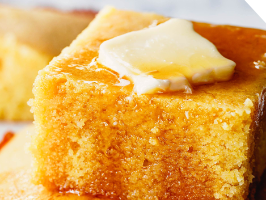
I’m not much of a cook, and therefore when I do, I usually follow the instructions with rigorous accuracy until undone by some detail the makers of recipes felt too obvious to include. But one substitution I always make is replacing the sugar in most recipes with honey because, well, of course I do. One of my favourite recipes to bring to a get together is corn bread because I can both substitute the sugar in it for honey and it is the perfect thing to drizzle honey on top of (and, as an American, it’s a part of my culture I can share).
The biggest consideration in substituting honey is changing the volume. Honey contains more sugar per volume than pure granulated sugar does. Yes, this is deeply counter-intuitive – but the reason is that granulated sugar consists of granules with air between them while honey as a liquid fills any given space (such as a measuring cup) completely. So one 240ml cup of granulated sugar contains about 200g of sugar but that same cup would contain 340g of honey.
Honey is, as you know, 13-18% water, we’ll use 15% as a nice rounded approximation. So of the 340g of honey in our cup, only 290g is sugars. But our example recipe called for one cup intending 200g of sugar, which means we need to use a third less honey, so 1 cup of granulated sugar equals 2/3rds of a cup of honey.
Okay but now we need to account for that added moisture itself, because it’s not nothing either. Of the 160ml of honey in the proposed 2/3rds cup, if 15% is water that’s appx 35ml.* Which means for every cup of sugar you’ve replaced with honey you need to reduce liquids by 35ml (ideally water, or milk, for other liquids you may have to further account for what flavour or other effects you’re losing by reducing).
The next big subject is browning and caramelization. These things happen to honey at different temperatures and rates than to sucrose, and this is more than an aesthetic consideration because it affects taste.
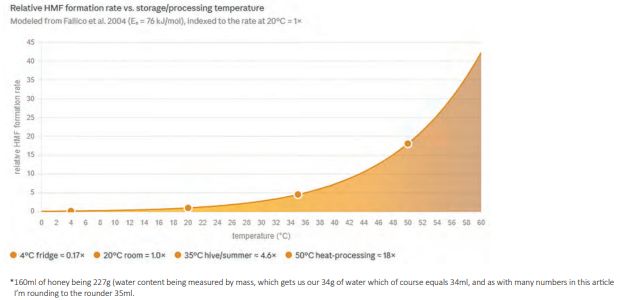
As you know, honey becomes brown and accumulates HMF over time, and if you heat honey (either repeatedly to reliquefy or expose it to extreme heat such as the honey you get from the wax separator) it gets both browner and accumulates HMF (generally regarded as a bad thing, can cause it to fail testing standards). If you have intuited that there’s a direct relationship between amount of heat applied and speed of accumulation of these things in honey, you’re right, and that’s why it’s hard to answer the question of at what temperature this begins to happen, it happens at all temperatures just at a different rate (though it does take a big jump over 50°C).
And sugar of course can be caramelized and browned, which does happen in any recipe in which it is baked or cooked, but one will note white granulated sugar in the bag never undergoes this, no matter how long it sits at 40 degrees. The reason for this is that sucrose is glucose and fructose melded into one molecule that can’t be browned or caramelized (a “non-reducing sugar”). When heated to 160°C it breaks down (“inverts”) into fructose and glucose (the two sugars that make up the bulk of honey), and fructose begins caramelizing around 110°C (and glucose at around 160°C).
So where does that leave us with practical conversion of recipes? Because honey is more sensitive to browning/caramelization, the temperature should be reduced by about 15°C.
That’s the bulk of the hard science of the conversions. One other consideration: fructose tastes sweeter than sucrose so the amount may need to be slightly reduced to prevent the recipe from coming out tasting too sweet.
Unless you’re producing something with an extremely light and delicate flavour, I wouldn’t use my best honey for cooking/baking – the delicate subtle flavours of a great varietal honey are volatile essences which can bake off just above 400C and are probably lost, and the subtle flavours would probably be overpowered by whatever other flavours are in the dish anyway. Baking is a good use for your canola, honey that’s already becoming browned from age or heat, or has too-high of a water content or is otherwise less than perfect.
Practically speaking, it’s hard to mix honey in to something else unless it’s been heated to be more liquid. I will shamelessly microwave a (glass) jar of honey for this – a minute in the microwave is nothing on the HMF formation chart above, though it will likely destroy enzymes and cook off the subtle volatiles, but those things would probably happen in the recipe anyway.
An added benefit is that honey is significantly more hygroscopic than sucrose, meaning it will remain moist and not go stale for much longer than the same recipe made with sucrose (all of which does not invert so it remains materially different in the end).
And finally, of course honey is better for you than the equivalent amount of sucrose. Studies have shown that people given a set amount of honey daily compared to a control group given the same amount of sucrose had total cholesterol, triglycerides, and LDL go down and HDL go up, while the sucrose group moved in the opposite direction on all four. In addition, honey is not just glucose and fructose, it includes small amounts of more complex sugars such as fructooligosaccharides (FOS), galactooligosaccharides (GOS), and potentially specific sugar compounds from the flower source such as isomaltose, melezitose, or raffinose, and these more complex sugars tend to be indigestible to human gut enzymes but are digestible to beneficial gut flora (a “prebiotic” effect), with various beneficial health effects for your gut.
Be aware there may be other recipe-specific ramifications of changing temp or time – for example one of my other signature dishes is flan, which is cooked in a double boiler, which, because it never actually exceeds 100°C, reducing the temperature unnecessarily slows the process, but putting foil over the top will prevent the honey getting too dark from direct radiant heat on top.
So in conclusion, sucrose in recipes can often be substituted with honey. If you’re reading this you are presumably a beekeeper and have plentiful honey at your disposal, and if preparing a dish to share with others, it’s always nice to showcase the uses of honey.
If this all seems like a lot of math, it’s really just:
• amount of honey = amount of sugar x 0.66
• liquid = -35ml per cup of sugar substituted
• +1g of baking soda per substituted cup.
And to make it even easier I made a calculator at:
www.krisfricke.github.io/recipe-calculator
Honey Cornbread
PREPARATION
Oven 190°C — Ten degrees below the original. Grease the tin.
INGREDIENTS
230 mL whole milk 10 mL less than the original 60 g honey ≈ 42 ml · replaces 50 g sugar 80 mL vegetable oil 50 g egg 1 large 140 g yellow corn meal 125 g plain flour 14 g baking powder ≈ 15 ml · not soda
INSTRUCTIONS
Dissolve honey into the milk first Whisk in vegetable oil, then egg Whisk smooth until the oil is fully emulsified
Whisk dry ingredients into a larger bowl (yellow corn meal, plain flour, baking soda, salt).
Combine wet into dry, stir until no dry flour remains. Lumpy is correct — 15 strokes at most, (overmixing makes it tough).
Bake into the greased tin • 190°C (−10 °C vs the original). 22–25 min, skewer/knife clean.
Test with a skewer/knife, not by colour — honey browns the crust before the middle is set. Rest 10 min in the tin. Serve with honey and a generous drizzle of fresh honey.
This article kindly peer reviewed from a professional culinary perspective by certified chef Ben Moore of Ben’s Bees: www.bensbees.com.au
References
1. Rasad H, Entezari MH, Ghadiri E, et al. (2018) “The effect of honey consumption compared with sucrose on lipid profile in young healthy subjects (randomized clinical trial).” Clinical Nutrition ESPEN. 2018;26:8–12.
2. Schell KR, et al., (2022) “The Potential of Honey as a Prebiotic Food to Re-engineer the Gut Microbiome Toward a Healthy State.” Frontiers in Nutrition. 2022;9:957932. doi:10.3389/fnut.2022.957932.