A Changing Landscape
By Lindsay Callaway, Commercial Beekeeper
As another almond pollination season draws to a close, beekeepers are doing what we always do — loading trucks, watching the weather, finding the next patch of flowers and saying over the UHF, “have a safe one!”
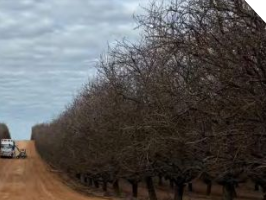
The 2026 season has again reminded me just how quickly the landscape around pollination is changing. Here in Victoria, we experienced another delayed start to flowering, with significant rainfall before and during bloom. Despite adequate winter chill, explaining a second consecutive year with later almond bloom isn’t necessarily straightforward. There were also concerns around the overlap between Nonpareil and its pollinators.
Early reports I’m hearing, however, are of a good to very good nut set. Time will tell.
Bees in good shape
From a beekeeper’s perspective, the general quality of Victorian bees has ranged from good to excellent.
Victorian colonies that went into autumn with a strong nutritional profile and wintered well in the Mallee on a host of weeds after all the pre-winter rain have generally presented particularly strongly. Almonds themselves have provided good stimulation. Colonies have bred well, there has been useful nectar coming in and, in general, many bees are leaving the orchards in great shape.
There is a lesson in that. The allure of low-nutrition autumn flows can be tempting, but it often catches up with us at almonds. We all know you cannot manufacture a genuinely strong pollination colony in the fortnight before delivery.
Quality starts months earlier
And now varroa has added another layer to that preparation. Some Victorian mites have already been confirmed resistant to both major synthetic miticide groups.1 The beekeeper delivering a strong colony today isn’t simply feeding and breeding bees. We are monitoring, treating, recording, checking treatment efficacy and increasingly working within an integrated pest management program.2 Those costs are real.
The new cost of keeping the pollinator alive
There has been plenty of discussion about pollination pricing. Personally, I think some of the adjustment we’re seeing is simply a correction towards the true cost of keeping the pollinator alive. Labour costs more. Trucks cost more. Treatments cost more. Monitoring takes time. Chasing nutrition and forgoing autumn honey costs money. Queen replacement costs money. And a treatment that fails because of resistance can cost considerably more than the product sitting inside the hive.
At the same time, frame-based pricing is creating a clearer financial reward for quality. I support that principle.
A beekeeper delivering genuinely strong colonies should be rewarded for the additional bees being placed into the orchard and hitting the stocking rates required. But it also makes accurate auditing more important than ever.
We need confidence in the audit
I’ve heard too many reports this season of beekeepers disagreeing substantially with third-party audit results. I’m clearly not alone.
AHBIC has publicly raised concerns regarding hive audits where reported colony strength has not aligned with what beekeepers believe they supplied and has encouraged beekeepers to be present during auditing where possible.
This matters. Growers deserve to receive what they have paid for. Beekeepers deserve to be paid for what they have supplied. And auditors need a transparent and repeatable system that gives both sides confidence. As more dollars become attached to each additional frame of bees, ambiguity is no longer good enough. The balance has to be right.
Where does the additional value go?
There is another question worth asking as frame pricing continues to develop: When stronger colonies create additional value, where does that value ultimately land? Does it flow back to the beekeeper carrying the increasing cost of producing and maintaining those colonies, or is some of that value being lost through the supply chain?
I can only speak from my own experience, but I remain a strong believer in the direct relationship between beekeeper and grower.
When the two people carrying the risk can sit down together and talk honestly about hive quality, price, timing, chemicals, weather and expectations, there is less room for misunderstanding.
That doesn’t mean there isn’t a place for brokers. There clearly is. But transparency will become increasingly important as the economics of pollination change.
Bee friendly doesn’t mean no risk
Chemical applications during flowering remains a concern for beekeepers. I also think communication between growers, agronomists and beekeepers is improving. That’s important and should be recognised. But as the value and importance of managed pollination increases, our understanding of the relationship needs to mature with it. Simply putting bees in boxes in an orchard and assuming everything else is somebody else’s problem no longer passes the pub test.
A strong pollination colony is a significant investment. It has taken months of nutrition, labour, queen management, varroa monitoring and treatment to get that colony into the orchard. And when it leaves almonds, that same colony may already be committed to another pollination crop or be central to the beekeeper’s spring production. That’s why the term “bee friendly” should never become shorthand for “no risk.”
The conversation cannot simply be whether an agricultural chemical kills adult bees outright.
We also need to think about exposure, brood and colony development, interactions between products, and the potential consequences after the hive leaves the orchard. Damage to a colony can represent a significantly greater financial cost to the beekeeper than the income received for providing the pollination service in the first place.
That doesn’t mean crops should never be sprayed. Growers have crops to protect and commercial realities of their own. It means communication matters.
Talk to the beekeeper. Talk to the agronomist. Understand what is being applied, why it is required, and when it can be applied with the lowest reasonable risk. Growers and beekeepers increasingly depend on one another.
Protecting the crop and protecting the pollinator should not be competing objectives.
Grower-owned bees — temporary fix or new normal?
Another fascinating development is the increasing discussion around grower-owned bees.
Are grower-owned colonies becoming part of a new pollination model, or are they a temporary response to uncertainty around future supply? I don’t pretend to know the answer.
There are considerable differences between owning bees and operating a sustainable commercial beekeeping business yearround. But growers investing directly in bees tells us something important about how seriously pollination security is now being taken.
The almond industry itself is also adapting. Recent Almond Board mapping shows that more than 25 percent of new almond trees planted over the past three years are self-fertile varieties, reducing some future pressure on managed pollination demand.3 That’s smart adaptation.
How far can our bees stretch?
Almonds are only the beginning of spring. As bees begin leaving the orchards, many are already committed elsewhere. Canola seed, cherries and other seed and horticultural crops all compete for healthy colonies — and for the beekeeper’s time.
Historically there has also been an enormous invisible buffer: unmanaged honey bees providing incidental pollination for free. varroa is changing that. The Australian Government reports that overseas feral European honey bee populations declined by more than 90 percent following the establishment of varroa.4
So the question isn’t simply whether Australia can supply enough bees for almonds. It is how far can Australia’s managed hive population stretch across all the crops that increasingly need it?
Pollination security is now national news and is increasingly finding its way into government, agricultural boardrooms and the wider community.5 The bees are coming out of the back paddock. That’s a good thing.
But recognition needs to translate into sustainable relationships between growers and beekeepers. Because ultimately, we need each other.
And despite all the economics, audits, varroa treatments, contracts and politics, sometimes it takes somebody seeing almond pollination for the first time to remind us what an extraordinary thing it actually is.
So I’ll hand over to Jana Hamilton, a commercial beekeeper from Far North Queensland who travelled almost 3,000 kilometres south and finally ticked almond pollination off her bucket list.
References
1. Agriculture Victoria. “Varroa mite – current situation.” Agriculture Victoria (Dept. of Energy, Environment and Climate Action).
2. Agriculture Victoria. “Miticide resistance in varroa mites: What Victorian beekeepers need to know.” Agriculture Victoria (Dept. of Energy, Environment and Climate Action).
3. Hollingworth, Kellie. “Almond industry plants to protect pollinators.” Australian Almonds (Almond Board of Australia), 2026 July 7th.
4. Australian Government Department of Agriculture, Fisheries and Forestry. “Honey bees, crop pollination and varroa mite — frequently asked questions.” DAFF.
5. Victorian Apiarist Association “The State of Beekeeping and Pollination Security in Victoria and Australia.” 2026 July