
As we approach our first Victorian winter with varroa mites, we must be even more careful to consider colony health. Bees in winter are different from those of the rest of the year. Instead of a work-weary demise after about 6 weeks, winter bees are longer lived. Indeed in climates much colder than ours, they may survive for as long as 6 months.
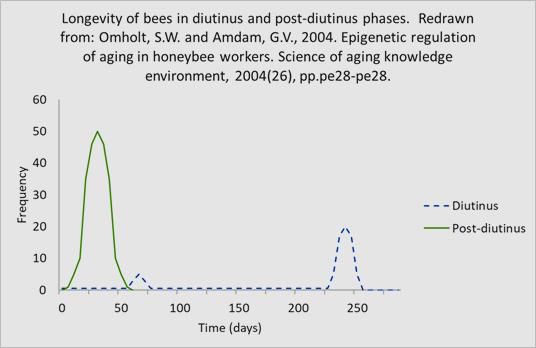
Last month Kris Fricke discussed the role of vitellogenin in honey bee biology1. To recap, it has various immune and protective functions as well as being responsible for suppressing Juvenile Hormone which itself leads to aging and maturation from nurse to forager roles.
In temperate climates, long-lived workers develop in autumn as the production of brood ceases before winter. Winter bees or diutinus bees closely resemble those of young summer hive bees, with well-developed hypopharyngeal glands, high titres of vitellogenin and low titres of juvenile hormone2, which is a releaser of foraging behaviour at high concentrations3. The transition from in-nest behaviour to foraging is delayed by several months in winter bees.
Impact of varroa on winter bees
When bees are infested with varroa during the pupal stage, vitellogenin levels are approximately halved compared to noninfested controls4. This results in a lower storage capacity for protein in infested bees indicating a physiological basis for the severe impact of V. destructor on honey bees in temperate zones. Failure to develop as long-lived winter bees makes them less likely to survive until spring. Colonies treated earlier in the season had reduced varroa infestation during the development of winter bees, resulting in longer bee lifespan and higher colony survival after winter5.
Now we come to a key consideration, what is the relevance to us, of studies performed in more severe winters? This is harder to ascertain and the National Varroa Mite Management program has consistently maintained that our environmental conditions are sufficiently different to mean overseas experience may not apply6. Studies of “tropical” bees seem unhelpful, as they largely relate to “Africanised” bees which have extreme variations in their grooming and absconding behaviours outweighing any wintering effects. One study from Argentina7 where climate conditions do not result in a broodless period, confirmed that early treatment and low initial mite loads both improved lowering of mite loads. We know that it is the length of time over which brood cells are available and not the total number, that exerts the greatest effect on mite population growth8. Thus damage from varroa is more severe in long brood rearing seasons than in short ones.
Treatment Timing
Despite any uncertainty due to our local environment, we should assume that delaying mite treatments to late autumn will impair the physiology of the winter bees and may result in colony losses. The message is clear; act early and don’t wait until winter pack down before making final treatment decisions. And speaking personally, I plan to treat as soon as I detect varroa in my hives, not waiting for any threshold to be exceeded. I want my bees in the best possible condition during winter.
Andrew Wootton is Vice President of the VAA and a certified master beekeeper with the Eastern Apicultural Society of N America. He first started beekeeping in the 1960s.
References
1. Fricke, K., 2026. Fat Bodies And Vitellogenin. Australian Bee Journal, 107 (3), 9-11
2. Fluri, P., Lüscher, M., Wille, H. and Gerig, L., 1982. Changes in weight of the pharyngeal gland and haemolymph titres of juvenile hormone, protein and vitellogenin in worker honey bees. Journal of Insect Physiology, 28(1), pp.61-68.
3. Schulz, D.J., Sullivan, J.P. and Robinson, G.E., 2002. Juvenile hormone and octopamine in the regulation of division of labor in honey bee colonies. Hormones and behavior, 42(2), pp.222-231.
4. Amdam, G.V., Hartfelder, K., Norberg, K., Hagen, A. and Omholt, S.W., 2004. Altered physiology in worker honey bees (Hymenoptera: Apidae) infested with the mite Varroa destructor (Acari: Varroidae): a factor in colony loss during overwintering?. Journal of economic entomology, 97(3), pp.741-747.
5. Van Dooremalen, C., Gerritsen, L., Cornelissen, B., van der Steen, J.J., van Langevelde, F. and Blacquiere, T., 2012. Winter survival of individual honey bees and honey bee colonies depends on level of Varroa destructor infestation. PloS one, 7(4), p.e36285.
6. https://agrifutures.com.au/product/varroa-destructor-research-strategy-2024-2027/
7. Giacobino, A., Molineri, A., Cagnolo, N.B., Merke, J., Orellano, E., Bertozzi, E., Masciángelo, G., Pietronave, H., Pacini, A., Salto, C. and Signorini, M., 2015. Risk factors associated with failures of Varroa treatments in honey bee colonies without broodless period. Apidologie, 46(5), pp.573-582.
8. Wilkinson, D. and Smith, G.C., 2002. A model of the mite parasite, Varroa destructor, on honeybees (Apis mellifera) to investigate parameters important to mite population growth. Ecological Modelling, 148(3), pp.263-275.